
Localised heat treatment makes it possible to apply a controlled heating and cooling cycle to a specific area of an industrial component. It is mainly used on welds, piping, pressure vessels and field repairs when placing the entire piece of equipment in a furnace is either impossible or inefficient.
This technique requires precise control of temperature, heating and cooling rates, soaking times and heat distribution. Incorrect execution can lead to thermal gradients, deformation or new stresses within the material.
For this reason, each treatment must be planned according to the metal composition, thickness, geometry, type of weld and the requirements established in the applicable procedure.
What is localised heat treatment?
Localised heat treatment consists of heating only the weld and a defined area of the adjacent material, rather than subjecting the entire component to a thermal cycle.
When carried out after welding, this procedure is known as localised post-weld heat treatment, or localised PWHT. Its usual purpose is to reduce residual stresses generated during welding and to modify certain properties of the material and the heat-affected zone.
Welding causes uneven heating and cooling. While the deposited metal and nearby areas reach high temperatures, the rest of the component remains at a lower temperature. This difference can cause contraction, microstructural changes and residual stresses.
Through a controlled thermal cycle, these stresses can be reduced, hardness can be adjusted and the stability of the joint can be improved. The results will always depend on the material and the procedure defined for the project.
When is localised heat treatment used?
Localised treatment is particularly useful when the size, geometry or location of the component prevents the process from being carried out in a fixed furnace.
It is commonly used in the following cases:
- Circumferential pipe welds.
- Repairs carried out during plant shutdowns.
- Joints between pipes, flanges and fittings.
- Welds on pressure vessels.
- Connections between nozzles and equipment.
- Components installed in refineries or power plants.
- Offshore and marine structures.
- Equipment too large to be placed inside a furnace.
- Interventions where dismantling the component is not feasible.
The main advantage is that heat treatment can be carried out in situ, acting only on the required area and reducing dismantling, transport and handling work.
However, the fact that the treatment is localised does not mean that its scope can be limited to the weld bead itself. A sufficiently wide heated band must be defined, and the temperature transition towards untreated areas must be controlled.
Differences between localised treatment and furnace heat treatment
In furnace heat treatment, the entire component is placed inside an enclosure where the temperature can be distributed uniformly. This is the most suitable option when the size of the component and the available facilities allow it.
In localised treatment, heat is applied to a limited area using electrical resistance heaters, induction systems or other equipment adapted to the component.
The main challenge is controlling thermal gradients. While the weld and treated band reach the required temperature, more distant areas remain at lower temperatures. If this transition is too abrupt, deformation or additional stresses may occur.
For this reason, the following parameters must be correctly calculated:
- Width of the heated band.
- Temperature control zone.
- Extent of the insulation.
- Position of the heating elements.
- Location and number of thermocouples.
- Heating and cooling rates.
- Soaking time.
- Permitted temperature difference between measurement points.
The choice between full and localised treatment must take into account the applicable standards, welding procedure, material characteristics and project conditions.
How is localised PWHT carried out?
The process begins with a technical assessment of the weld and the component. At this stage, the base material, thickness, diameter, geometry, access conditions and requirements of the applicable code or specification are analysed.
Based on this information, the heat treatment procedure is defined.
Preparation of the area
Before installing the equipment, the surface is inspected and the area to be heated is defined. Any nearby elements that could be affected by the temperature are also assessed.
Preparation must ensure proper contact between the component, heating elements and sensors.
Installation of the heating elements
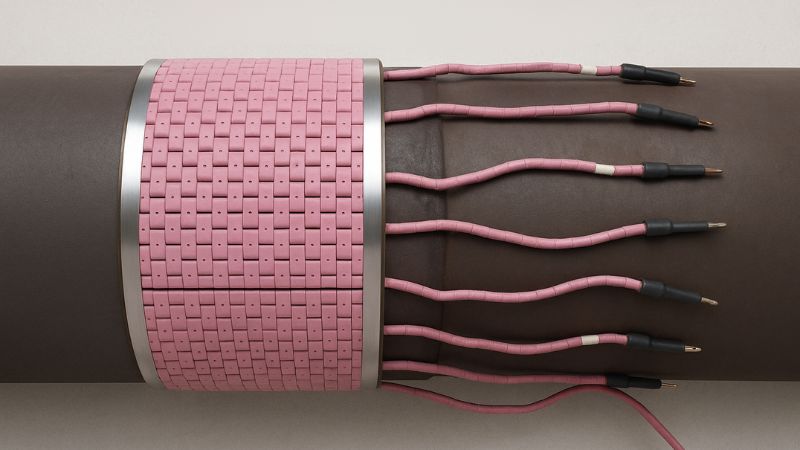
Flexible electrical resistance heaters are commonly used for local applications and are available in formats such as heating pads, bands or coils.
These elements can be adapted to piping, flanges, vessels and other industrial geometries. They are distributed around the weld to provide uniform heat input.
Another option is induction heating, which generates heat through electromagnetic fields. This method can be particularly useful when rapid, localised energy transfer is required.
Installation of thermal insulation
Thermal insulation reduces heat loss and helps distribute the temperature uniformly. It also assists in controlling heating and cooling rates.
It must cover both the heated area and the additional area required to provide a gradual thermal transition towards the rest of the component.
Installation of thermocouples
Thermocouples are attached at strategic points to measure temperature development. Their number and location will depend on the size, geometry and tolerances defined in the procedure.
Incorrect positioning can result in readings that do not accurately represent the actual temperature of the weld or the heat-affected zone.
The sensors are connected to programmers and data recorders that control the cycle and generate a record of the heat treatment.
Execution and recording of the thermal cycle
Once the system has been prepared, heating begins in accordance with the specified temperature ramp. After the required temperature has been reached, it is maintained for the defined period before controlled cooling begins.
Thermocouple readings are monitored throughout the process. If deviations are detected, the technical team must assess the necessary adjustments in accordance with the procedure.
Temperature recording provides traceability and makes it possible to demonstrate that the cycle has been carried out within the established parameters.
Methods used in localised heat treatments
Electrical resistance heating
Resistance heating is one of the most widely used methods for field repairs and localised heat treatments.
Its flexibility makes it suitable for piping, circumferential welds and components with complex geometries. It also allows the treatment area to be divided into different control channels.
Induction
Induction heating uses coils to generate induced currents in the metal. It allows energy to be applied rapidly and in a controlled manner to specific areas.
The coil design, power and distance from the component must be calculated according to the geometry and material properties.
Portable furnaces
When an entire component needs to be treated but cannot be transported to a fixed furnace, portable furnaces can be built around the component.
This solution is useful for large components, pipe prefabrication and projects carried out directly at the customer’s facilities.
Localised heat treatments with Intec Heat
At Intec Heat, we carry out the assessment, planning and execution of post-weld heat treatments both in the workshop and in the field.
We have electrical heating equipment, induction systems, automatic programmers, data recorders and thermocouples to adapt each cycle to the characteristics of the component.
Our technicians control the different stages of the treatment and generate the necessary records to ensure full process traceability.
Each localised heat treatment requires a specific solution. Proper analysis of the material, geometry, weld and execution conditions is essential to achieve uniform temperature distribution and obtain the results defined in the procedure.
Contact Intec Heat to discuss your project’s requirements and design the most suitable heat treatment solution.