
Induction heat treatment uses an electromagnetic field to generate heat directly within a metal component. This technology enables fast, localized and controlled heating, making it particularly useful in industrial processes such as weld preheating and post-weld heat treatment (PWHT).
The main advantage over other heating systems is not just speed. Induction heating makes it possible to adapt heat input to the geometry and specific area being treated, while maintaining precise temperature control throughout the process. At Intec-Heat, we use this technology across various industrial sectors, both for stationary applications and certain moving components.
How Does Induction Heat Treatment Work?
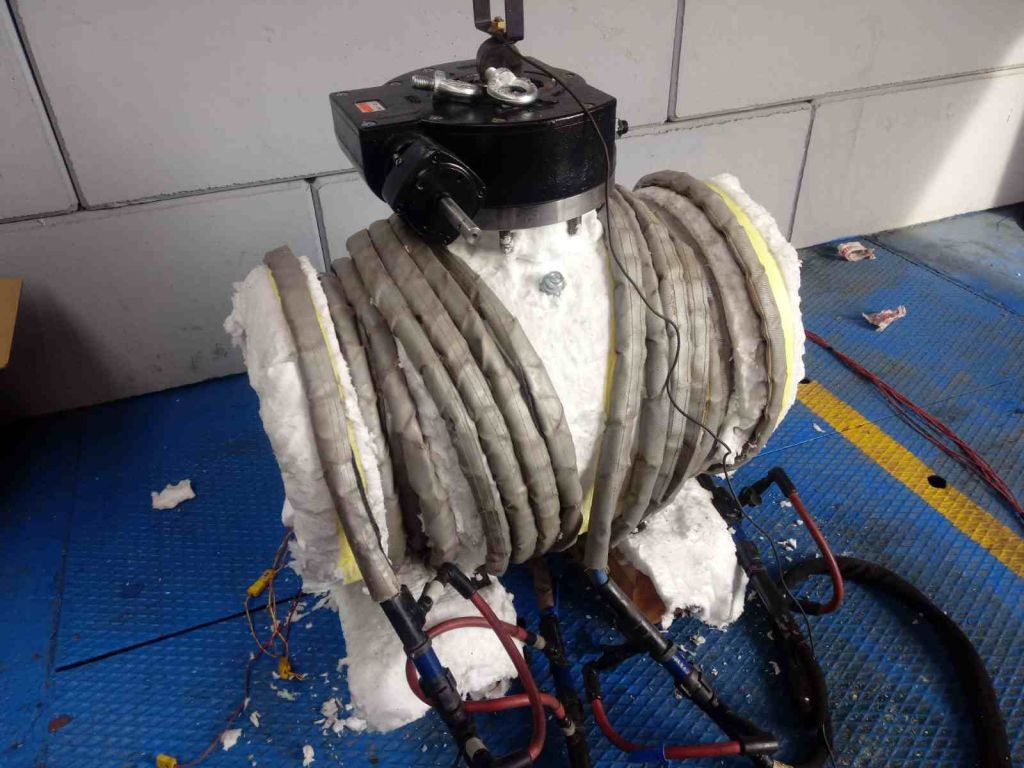
Induction heating is based on the generation of an alternating electromagnetic field. To achieve this, cables or induction coils are placed around the area to be heated.
When alternating current flows through the system, the electromagnetic field induces electrical currents within the metal component itself. These currents generate heat directly in the material, without the need to first heat a resistance element that subsequently transfers energy to the component.
The system configuration depends on each application. The number of turns, cable length, positioning relative to the component and power output must all be calculated to achieve the required temperature distribution.
For this reason, induction heat treatment involves more than simply wrapping a cable around a component and applying electrical current. It requires a prior assessment of the component’s characteristics and a clear definition of how heating should be carried out.
What Are the Stages of Induction Heat Treatment?
Although the procedure varies depending on the treatment, it generally begins with a technical assessment of the component and its thermal requirements.
Key factors to consider include:
-
Component material and properties
-
Thickness and dimensions
-
Geometry of the area to be heated
-
Target temperature
-
Treatment area
-
Welding procedure, in the case of a welded joint
-
Working conditions and available space
Based on this information, the induction system is configured and the arrangement of cables or induction coils is determined.
The temperature measurement and control systems are then installed to monitor the actual temperature of the component. During the process, power output is adjusted to achieve and maintain the specified parameters.
What Are the Benefits of Induction Heating?
Induction heating offers particularly valuable characteristics when a specific area of an industrial component needs to be heated.
Fast Heating
Because heat is generated directly within the material, induction heating can quickly reach the target temperature. This can be especially useful in operations where production, assembly or repair times are critical.
Localized Heating
Energy can be concentrated in the area requiring treatment, avoiding unnecessary heating of other parts of the component.
This is particularly beneficial for welds, pipes and components where precise control of the heat-affected area is required.
Process Control
Induction heating can be combined with thermocouples, sensors and automatic control systems to maintain temperatures within the specified parameters.
This makes it possible to monitor the treatment and generate temperature records throughout the process, which is particularly important in industrial applications requiring traceability.
Uniform Temperature Distribution
When the system is correctly designed, induction coils can be configured to achieve uniform temperature distribution around pipes and other cylindrical components.
Improved Safety in Certain Applications
Induction heating does not require incandescent heating elements to be applied directly across the entire surface being treated. This can reduce certain risks associated with exposed heating elements.
Which Heat Treatments Use Induction Heating?
Induction technology can be used in various thermal processes. At Intec-Heat, it is particularly important for weld preheating and post-weld heat treatment.
Weld Preheating
Before and during certain welding operations, the material must be maintained at a specified temperature. The aim is to control the cooling of the welded joint and reduce certain risks associated with the process.
Induction heating makes it possible to rapidly increase the temperature of the required area and keep it under control throughout welding. The specific temperature must be established according to the material, thickness, welding procedure and project specifications.
In induction preheating, this technology is used in applications involving pipes, pressure vessels and thick-walled components, among others.
Post-Weld Heat Treatment (PWHT)
PWHT is performed after welding, primarily to relieve residual stresses generated during the welding process.
Induction heating allows the metal to reach the required treatment temperatures using high-frequency cables. Correct coil arrangement and cable length are essential to achieving the intended results.
In certain repairs and localized operations, this solution makes it possible to treat specific areas without placing the entire component inside a furnace.
PWHT treatments can be carried out using different technologies, including electrical resistance heating, induction heating and fuel-fired heating methods.
What Are the Industrial Applications of Induction Heat Treatment?
The ability to provide fast, localized heating makes induction technology suitable for a wide range of industrial environments.
Applications include:
-
Pipelines and piping: Preheating and localized heat treatment of welded joints.
-
Pressure vessels: Thermal processes on joints and components requiring precise temperature control.
-
Heavy fabrication: Heat treatment of thick-walled components.
-
Oil & Gas: Operations in refineries, petrochemical plants and process equipment.
-
Offshore: Heat treatment of large structures and welded joints.
-
Shipbuilding: Construction and repair of structures and components.
-
Energy: Thermal applications involving industrial components and structures.
-
Prefabrication and maintenance: Repetitive processes or repairs requiring localized heating.
These sectors are part of Intec-Heat’s areas of expertise, alongside the steel, aerospace and cement industries.
Can Induction Heating Be Used on Moving Components?
Yes, specific configurations are available for certain applications.
For components that rotate during welding, mobile or rolling induction coils can be used. These systems maintain heating while the component is moving.
At Intec-Heat, we use solutions equipped with sensors that detect component movement. If the component stops unexpectedly, the system can automatically shut down to prevent localized overheating.
This is particularly useful in industrial processes where the component does not remain stationary throughout the operation.