
Weld preheating in refineries involves raising and controlling the temperature of the material surrounding the area to be welded before welding begins. Its purpose is to control the cooling rate of the joint and reduce certain metallurgical risks, particularly in materials, thicknesses and welding conditions susceptible to cracking.
In a refinery, where pipes, pressure vessels, columns and other equipment operate under demanding service conditions, proper temperature control during welding is an important part of the work. Preheating temperature is not universal: it must be determined according to the material, thickness, welding procedure and specifications applicable to the project.
Why Is Weld Preheating Important in a Refinery?
During welding, a specific area of the material reaches high temperatures and subsequently begins to cool. This temperature difference can create conditions that promote certain defects.
Preheating slows down the cooling of the weld and base metal, allowing more time for hydrogen to diffuse and reducing the likelihood of forming excessively hard microstructures susceptible to cracking.
Some of the factors that can be controlled through properly designed preheating include:
- The risk of hydrogen-induced cracking in certain steels
- The cooling rate of the joint
- The formation of excessively hard microstructures
- Thermal stresses generated during welding
- The stability of welding conditions between passes
This is particularly relevant in refineries because many operations involve thick-walled components or equipment whose repair and fabrication require precise thermal control.
What Factors Determine the Preheating Temperature?
There is no single temperature that can be applied to every weld in a refinery.
The required temperature must be established based on the material characteristics and welding procedure. Factors to consider include:
- Material chemical composition: influences susceptibility to certain cracking mechanisms.
- Thickness: thicker components may exhibit different cooling conditions.
- Joint geometry: joint configuration and degree of restraint affect thermal behaviour.
- Welding consumables and procedure: hydrogen input and heat input are relevant variables.
- Interpass temperature: must remain within the specified limits throughout welding.
- Applicable code or specification: the procedure must comply with the technical requirements established for the project.
Where Is Preheating Applied in a Refinery?
Refining facilities contain numerous components that require welding during fabrication, installation, maintenance or repair.
Some of the most common applications include:
Piping and Process Lines
Industrial piping systems incorporate numerous circumferential welds and connections that may require preheating before and during welding.
Thermal control helps maintain the conditions specified in the welding procedure, even when working with substantial thicknesses or particularly demanding materials.
Pressure Vessels
Pressure vessels require precise control of fabrication and repair operations.
Preheating may form part of the welding procedure for various components, particularly when the material and joint characteristics make it necessary to control the cooling rate.
Columns and Process Equipment
Industrial columns are among the largest pieces of equipment found in refineries. Due to their dimensions and construction characteristics, certain welding operations require thermal solutions adapted to the equipment itself.
Intec-Heat specialises in the heat treatment of large Oil & Gas equipment, including columns, storage spheres and pipe racks.
Repairs During Plant Shutdowns
During a maintenance shutdown, repair or modification work may involve new welds.
In these cases, the thermal solution must be adapted to the actual conditions of the facility and the time available to complete the work.
What Preheating Methods Are Used?
The technology used depends on the geometry, material, required temperature, weld configuration and working conditions.
At Intec-Heat, we mainly use electrical resistance heating and induction heating, as well as specific solutions for moving components.
Electrical Resistance Preheating
Heating elements are placed around the weld area to transfer heat to the component. Their flexibility allows them to adapt to different geometries and establish separate heating zones.
Ceramic heating elements, for example, can be used for both longitudinal and circumferential welds on pipes, vessels and other components. Their modular design allows different units to be connected for precise temperature control.
This solution is particularly suitable when localised heating and a thermal distribution adapted to the component geometry are required.
Induction Preheating
Induction generates an electromagnetic field that heats the metallic material directly.
One of its main characteristics is rapid heating, along with the ability to concentrate heat input in the required area. It can be particularly useful for piping, thick-walled components and projects where execution times are especially important.
At Intec-Heat, we use induction cables and, when required by the application, water-cooled cables to improve operational safety during the process.
What Happens When Components Are Moving?
Some welding operations are performed on cylindrical shell sections that rotate during welding. In these applications, it is not always possible to use a conventional heating element directly on the surface.
Intec-Heat offers radiant heating systems using resistance elements and induction solutions with rolling inductors. These systems incorporate sensors and control mechanisms that automatically interrupt heating if the component stops unexpectedly, preventing localised overheating.
How Is Temperature Controlled During Preheating?
Applying heat is not enough. It is essential to verify that the component reaches and maintains the specified temperature.
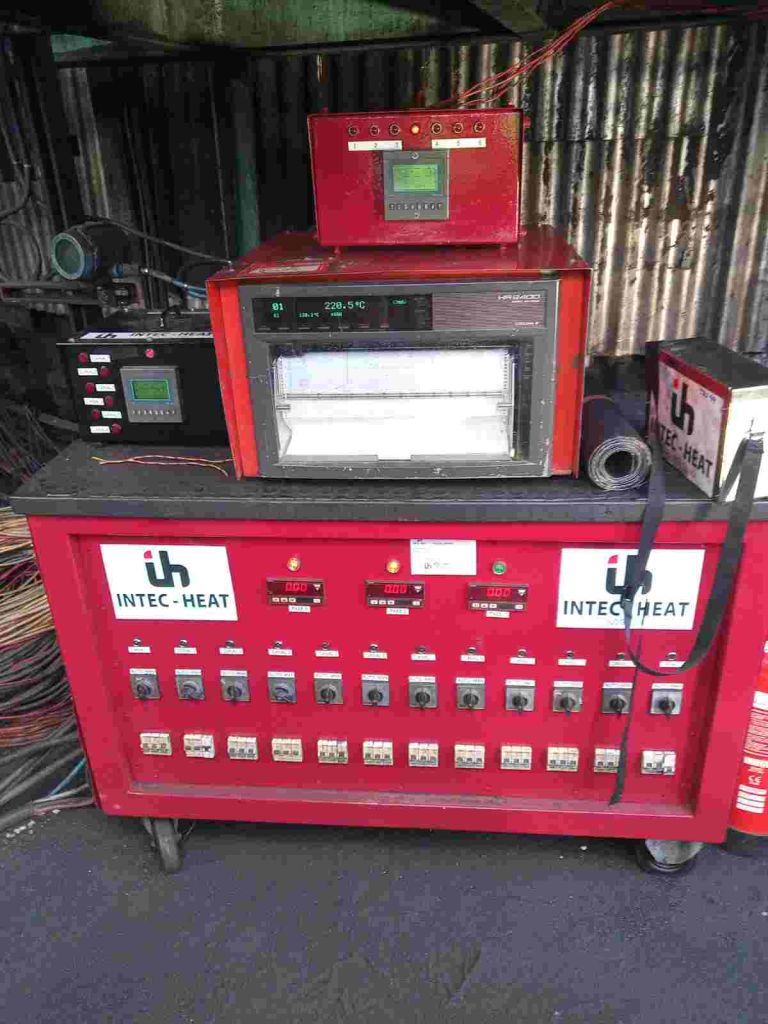
Thermocouples, infrared sensors, automatic controllers and temperature recording systems can be used for this purpose. These devices make it possible to monitor temperature changes throughout the operation and detect potential deviations.
Control is particularly important when working with large components, as a seemingly correct temperature at one point does not guarantee that the entire area of interest is within the specified parameters.
In Intec-Heat systems, sensors and controllers allow the process to be monitored and adjusted in real time. Certain applications also incorporate remote control systems and automatic shutdown mechanisms.
What Is the Difference Between Preheating and PWHT?
Although both are thermal treatments associated with welding, they are performed at different stages and serve different purposes.
Preheating is carried out before welding and may be maintained during the operation to control cooling and the thermal conditions of the joint.
PWHT (Post Weld Heat Treatment) is applied after welding and one of its main purposes is to relieve residual stresses generated during the process.
In a refinery, both may form part of a thermal control strategy for a welding operation, but they should not be confused.
Why Is Preheating Especially Important in Oil & Gas Facilities?
Refineries operate equipment and systems involving metallic materials, demanding mechanical requirements and operating conditions that require rigorous control of maintenance and repair activities.
Furthermore, many operations involve large components that cannot easily be transported to a conventional heat treatment facility.
This makes on-site solutions particularly important. Thermal equipment must be adaptable to the component, capable of controlling the required temperatures and able to document the process.
Intec-Heat has more than 35 years of experience in preheating, PWHT and refractory dry-out, as well as its own fleet of heat treatment equipment and an international presence.
Our activities in the Oil & Gas sector include work on large equipment such as columns, storage spheres and pipe racks.
Preheating Tailored to Each Weld
Weld preheating in refineries must be approached as a technical process in which the material, welding procedure, geometry, temperature and control system are interconnected.
It is not simply a matter of reaching a specific temperature. Appropriate heat distribution must be achieved and the specified conditions maintained throughout welding.
At Intec-Heat, we assess the characteristics of each project to select the most suitable heating technology, whether electrical resistance or induction, and define the necessary measurement and control systems.
This combination of thermal engineering, suitable equipment and process monitoring enables us to carry out preheating work on pipes, vessels, columns and other components in refining and Oil & Gas facilities.
Frequently Asked Questions
Do All Welds in a Refinery Require Preheating?
No. The need for preheating and the required temperature depend on the material, thickness, welding procedure, consumables, geometry and applicable technical requirements.
Which Method Is Best for Preheating a Weld?
There is no universal method. Electrical resistance heating offers considerable flexibility to adapt to different geometries, while induction provides rapid, controlled heating. The choice depends on the project conditions.
Does Preheating Prevent Weld Cracking?
It cannot be guaranteed to eliminate the risk completely. Properly specified preheating can reduce certain risks, particularly hydrogen-induced cracking in susceptible materials, by controlling the cooling rate.
Should Interpass Temperature Be Controlled?
Yes. Interpass temperature is part of the welding procedure conditions and must remain within the limits specified for the particular material and process.
Can Preheating Be Carried Out Directly at the Refinery?
Yes. Resistance heating and induction systems allow on-site preheating, even on large components and certain moving parts, provided the solution is designed according to the working conditions.