
Preheating is a fundamental operation in many industrial welding processes. Its purpose is to raise and control the temperature of the workpiece before welding begins in order to reduce the thermal gradient, slow down cooling and minimise the risk of defects.
Correct heat application can help prevent issues such as hydrogen-induced cracking, the formation of excessively hard structures or the build-up of thermal stresses in the welded joint. It also helps maintain more stable conditions during welding, especially in thick components, alloy steels and structures subjected to high mechanical demands.
Among the most widely used technologies for this process are electrical resistance preheating and induction preheating. Although both methods aim to achieve the same result, they generate and transfer heat in different ways.
Choosing the most suitable system will depend on the material, component geometry, required temperature, production rate and the specific conditions of the project.
What does weld preheating involve?
Preheating consists of applying heat in a controlled manner to the area to be welded and to the surrounding material. The workpiece must reach the temperature established in the welding procedure before the operation begins.
The required temperature cannot be determined generically. It must be established taking into account factors such as:
- Chemical composition of the material.
- Workpiece thickness.
- Degree of joint restraint.
- Welding procedure and consumable.
- Expected heat input.
- Applicable standard or code.
- Potential hydrogen content.
In addition to reaching the preheat temperature, it is important to control the interpass temperature. Irregular or poorly monitored heating can generate thermal differences between different points of the component and affect the final quality of the joint.
For this reason, a preheating system should not be assessed solely on the basis of its power. Heat distribution, regulation capability and temperature traceability are equally important.
Preheating using electrical resistance heaters
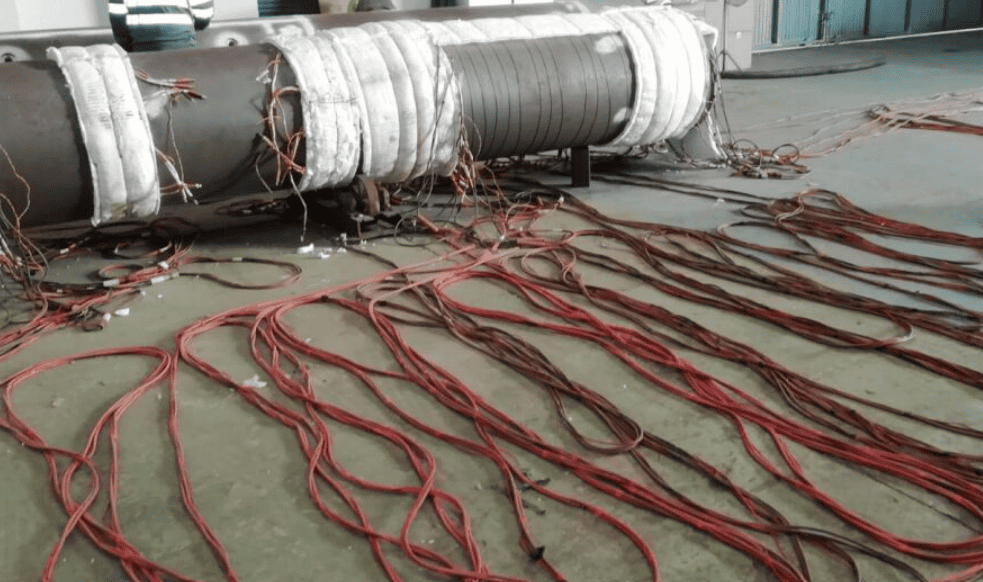
Electrical resistance preheating uses heating elements positioned in contact with the workpiece or at a defined distance from its surface. When electric current flows through them, these elements heat up and transfer energy to the component through conduction and radiation.
The heaters can be installed as blankets, bands or ceramic modules. Their flexibility allows them to be distributed around pipes, welded joints and components with different geometries.
Intec Heat uses this technology both in static installations and in special applications involving moving components. In static work, the resistance heaters are placed around the weld area. For shells or cylindrical sections that rotate during the process, non-contact radiant systems can be used in combination with infrared sensors and safety devices.
Advantages of electrical resistance heating
Resistance heating stands out for its versatility. Heating elements can be distributed across different zones and controlled independently to adapt the heat input to the geometry of the component.
Its main advantages include:
- Good adaptability to pipes and complex components.
- Possibility of creating multiple heating zones.
- Established and widely used technology.
- Suitable for localised heat treatment.
- Easy combination with thermal insulation.
- Control using thermocouples and automatic programmers.
However, to achieve a uniform temperature, the heaters and insulation must be installed correctly. Poor positioning, insufficient contact or inadequate distribution may create cold spots and temperature differences.
It should also be taken into account that heating elements retain heat after they are switched off. They must therefore be allowed to cool before being handled or removed.
How does induction preheating work?
Induction heating works by generating an alternating electromagnetic field. This field induces electrical currents inside the metallic component, known as eddy currents, which generate heat within the material itself.
Unlike electrical resistance heating, the heat source does not need to reach a high temperature in order to transfer heat to the workpiece. The metal itself acts as the heating element.
This technology can be applied using induction cables wound around the component, purpose-designed blankets or inductors engineered for a specific application. Depending on the equipment and required power, the cables may incorporate cooling systems.
Advantages of induction heating
One of the main advantages of induction is its heating speed. Since heat is generated directly within the material, certain losses associated with heat transfer from an external element are reduced.
This technology also offers:
- Rapid response to changes in control settings.
- Good uniformity around pipes and cylindrical components.
- No incandescent heating elements.
- Ability to maintain a stable temperature during welding.
- Suitability for automated or repetitive processes.
- Application to both static and moving components.
For rotating components, a mobile or rolling inductor equipped with motion detection systems can be used. If the component stops unexpectedly, the equipment can interrupt heating to prevent excessive energy concentration.
However, induction also requires correct application engineering. Cable layout, number of turns, distance from the workpiece, available power and the electromagnetic properties of the material all affect the result.
Induction versus electrical resistance heating
There is no single technology that is superior in every situation. The choice should be made after analysing the technical and operational requirements of each project.
| Criterion | Electrical resistance | Induction |
|---|---|---|
| Heat generation | The heater warms up and transfers energy to the workpiece | Heat is generated within the material itself |
| Geometric adaptability | Highly flexible using blankets and modules | Requires configuring the cable or inductor |
| Heating speed | Generally progressive | Usually faster |
| Zone control | Allows independent circuits to be installed | Depends on the design of the induction system |
| Localised applications | Very common in repairs and welding | Feasible with the correct configuration |
| Repetitive processes | Suitable | Particularly attractive because of its speed |
| Moving components | Specific radiant systems | Mobile or rolling inductors |
| Auxiliary installation | Heaters, insulation and control | Induction unit, cables and possible cooling |
The importance of temperature control
Regardless of the technology selected, temperature control is an essential part of preheating. It is not enough to apply heat: it is necessary to verify that the weld area reaches the specified value and remains within the permitted limits.
Thermocouples, infrared sensors, automatic programmers and temperature recorders can be used for this purpose. These instruments make it possible to regulate power, detect deviations and document the progress of the process.
Traceability is particularly relevant in sectors such as power generation, the petrochemical industry, pressure vessel manufacturing, shipbuilding, the wind industry and pipeline maintenance.
Preheating solutions adapted to each project
At Intec Heat, we provide industrial preheating services using electrical resistance and induction systems, for both static applications and moving components.
Each project is assessed taking into account the material characteristics, component geometry, welding procedure and working conditions. Based on this analysis, the heating technology, sensor layout, control system and required power are defined.
Correctly selecting the preheating method helps improve thermal uniformity, reduce metallurgical risks and increase the reliability of the welded joint. Rather than choosing between induction and resistance heating in generic terms, the key is to design a thermal solution adapted to the actual requirements of each operation.