
There has already been extensive coverage of the expected expansion of the offshore wind sector by 2026. Consequently, new requirements are currently being introduced for the manufacturing processes of critical components such as offshore jackets.
These structures, essential for supporting offshore wind turbines, require precise thermal control throughout all stages of production.
Why are thermal requirements in offshore wind increasing by 2026?
The entry into force of European regulations and the need for larger, more robust structures necessitate the application of stricter heat treatments in metal fabrication. The goal is to ensure a series of key points:
- Structural integrity in extreme environments.
- More stable welds that are resistant to marine stress.
- Longer service life against moisture, salinity, and dynamic loads.
Fundamental Thermal Processes in Offshore Jacket Manufacturing
Jackets require multi-stage heat treatments to ensure robust welds and stable long-term mechanical performance.
Weld Preheating: The Essential First Step
Before beginning to weld thick-walled components, weld preheating is performed, which:
- Reduces internal stresses.
- Prevents cracks in critical joints.
- Improves weld bead quality in cold or humid climates.
Offshore jacket preheating is now standard practice in shipyards and metal fabrication plants.
Post-weld heat treatment in offshore structures
Post-weld heat treatment is essential to ensure the stability of joints after welding. By 2026, an increase in PWHT is expected for components intended to operate under dynamic loads, such as:
- Pipe joints.
- Structural joints.
- Critical connections to bases, transitions, or platforms.
Induction Heat Treatment for Highly Complex Welds
Induction heat treatment allows for rapid, localized heating of specific areas, making it ideal for:
- Hard-to-reach components.
- Welds requiring pinpoint precision.
- Structures with complex geometries.
Their speed and control help reduce manufacturing times without compromising quality.
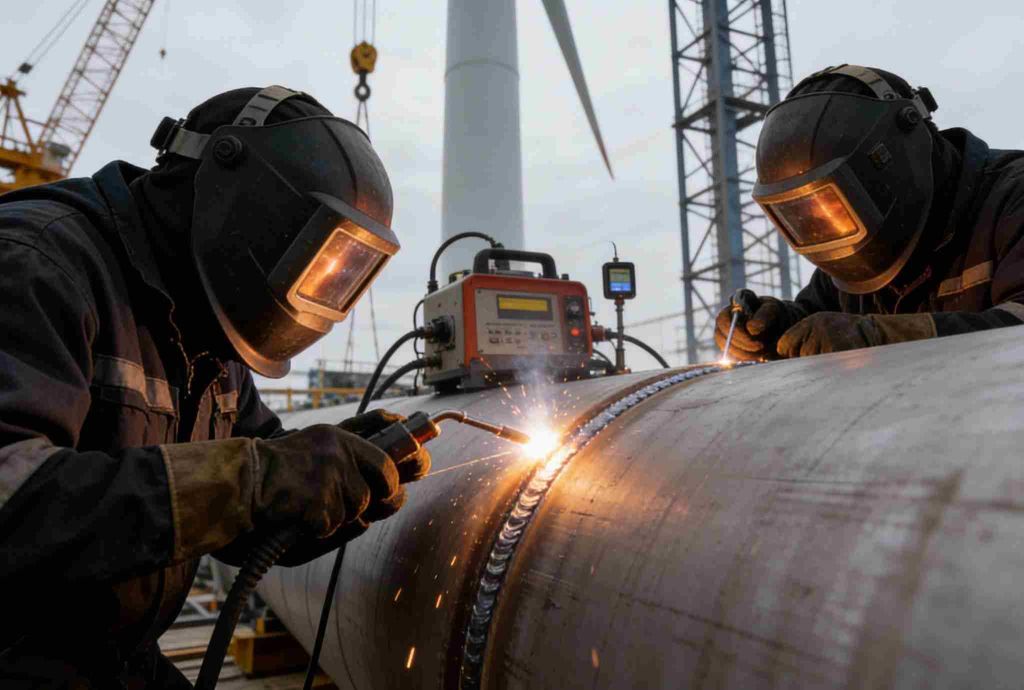
Application of Heat Treatments on Offshore Platforms and in Offshore Environments
The manufacture of jackets and associated structures requires a combination of thermal techniques:
- Preheating of oil platforms
- Preheating of sleeves in swivels
- Heat treatment of pressure vessels
- Drying of refractories in furnaces supporting metallurgical processes
- High-temperature solutions for components subjected to extreme temperatures
The atmospheric conditions of the marine environment influence the process, so precise thermal planning is required.
Thermal technologies that will set the trend in 2026
Starting in 2026, intensive use is expected of:
Advanced Thermal Control with Multi-Channel Data Loggers
The 12-, 24-, or 30-channel data loggers enable continuous monitoring, ensuring:
- Complete process traceability.
- Immediate alarms in the event of thermocouple failures.
- Compliance with offshore certification body specifications.
Ceramic heating elements for uniform preheating
Ideal for circumferential or tubular welds, capable of operating up to 1050 °C, with high flexibility for curved surfaces.
Capacitive Welding of Thermocouples
Essential for accurately and reliably attaching sensors to jackets and structural nodes, preventing erroneous readings.
The offshore wind industry is poised for unprecedented growth by 2026. The proper execution of preheating, post-welding, induction treatments, and high-temperature solutions will be critical to manufacturing larger, stronger structures designed for decades of offshore operation.