
Preheating in welding is a critical process when working with submarine structures, where the reliability of every joint is essential to ensure the safety and performance of equipment in service.
In these applications, materials are exposed to extreme conditions of pressure, temperature, and corrosion. Proper thermal control prior to welding helps prevent metallurgical issues that could compromise structural integrity.
Applying appropriate preheating reduces risks such as cold cracking, the accumulation of diffusible hydrogen, and the formation of residual stresses—factors that can negatively affect long-term material performance.
For this reason, preheating should not be considered a secondary step in the welding process. In naval, offshore, and industrial projects, it is an integral part of qualified welding procedures, as it directly influences the final quality of the joint.
What are the main objectives of preheating in submarine welding?
Preheating serves several key technical functions in the fabrication and maintenance of submarine structures:
- Prevention of cold cracking
High-strength steels used in naval applications are more susceptible to hydrogen-induced cracking, especially when cooling occurs too rapidly. Preheating slows down the cooling rate and promotes hydrogen diffusion, significantly reducing the likelihood of cracks forming in the heat-affected zone. - Improved thermal distribution
When the base material is preheated, temperature is distributed more evenly during welding. This minimizes thermal differences between the weld zone and the rest of the component, helping to prevent metallurgical defects and improve the uniformity of mechanical properties. - Reduction of residual stresses
Welding thick or highly rigid components generates internal stresses that may lead to deformation or cracking. Preheating helps minimize these effects by reducing thermal gradients and stabilizing material behavior during the process.
Preheating temperature ranges are typically defined according to international standards such as ASME Section IX or ISO standards, taking into account factors like material type, thickness, and the welding procedure used.
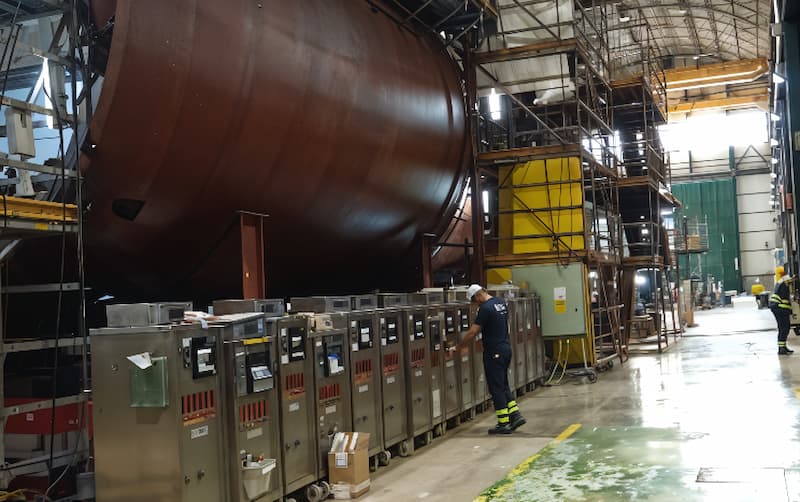
What benefits does controlled preheating provide for submarine durability and safety?
In naval and offshore environments, thermal control during welding is essential to ensure structural durability:
- Reduction of diffusible hydrogen
Preheating helps remove surface moisture and reduces the presence of diffusible hydrogen. This is particularly important in high-strength steels or thick-section welds. - Improved performance under dynamic loads and fatigue
Proper temperature management leads to a more stable microstructure in the heat-affected zone, improving resistance to vibrations, impacts, and cyclic loads—common conditions in submarine environments. - Compliance with standards and certification requirements
Preheating procedures are part of certification requirements. Regulatory bodies require temperature monitoring and recording during welding to ensure process quality.
What preheating techniques are used in submarine welding and how are accessibility and control managed?
The choice of preheating method depends on factors such as component geometry, accessibility, and the level of thermal control required:
- Electrical resistance preheating
Heating elements or thermal blankets allow controlled and uniform heat application. This method offers high precision and is commonly used where there is sufficient access to install heating systems. - Induction preheating
Induction heating enables rapid heating with uniform thermal distribution. It is particularly effective in complex configurations or areas with limited access, where other methods are more difficult to implement. - Temperature control and monitoring
To ensure effective preheating, temperature must be verified using systems such as thermocouples, infrared sensors, or multi-channel thermal control equipment. Tools like thermal crayons and infrared devices help ensure temperatures remain within specified welding procedure limits. - Accessibility and environmental conditions
In confined or hard-to-reach areas, flexible resistance systems and induction equipment offer better adaptability. Environmental conditions—especially ambient temperature and humidity—must also be considered, as they can affect thermal stability and preheating effectiveness.
How does preheating help reduce stresses and defects in submarine structures?
Preheating plays a key role in controlling thermal phenomena during welding, helping reduce internal stresses and minimize metallurgical defects:
- Reduction of thermal gradients
A preheated material exhibits smaller temperature differences between the weld zone and base material, reducing the formation of brittle areas and lowering the risk of microcracking during cooling. - Deformation control
Welding thick or rigid components can lead to distortions due to uneven cooling. Preheating stabilizes thermal behavior and helps maintain dimensional control. - Complement to post-weld heat treatment (PWHT)
Combining proper preheating with post-weld heat treatment significantly reduces residual stresses generated during welding, improving structural performance under demanding service conditions.
Thermal control during welding is a decisive factor in ensuring that the mechanical properties defined in the design are maintained throughout the service life of the submarine structure.
Why is preheating indispensable in submarine welding?
Preheating is a critical parameter in qualified welding procedures for submarine applications, as it directly impacts structural integrity and joint reliability:
- Prevents cold cracking, especially in high-strength steels
- Reduces diffusible hydrogen in the welded joint
- Minimizes internal stresses and deformation risks
- Supports compliance with quality standards and procedures
- Enhances structural durability and safety
- Ensures traceability and process quality control
Preheating as a key factor in submarine structural reliability
Preheating is an essential element in welding procedures applied to submarine structures. Its proper implementation ensures weld quality and compliance with international codes, standards, and certification body requirements.
At Intec-Heat, we develop preheating solutions tailored to the technical requirements of each project, integrating heating technologies and control systems to ensure thermal stability and process repeatability.
Our technical team can provide guidance on defining preheating procedures, selecting appropriate equipment, and complying with applicable standards—ensuring maximum reliability and durability of welded joints in naval applications.