
In industrial sectors such as Oil & Gas, naval, and offshore, many pieces of equipment operate under extremely demanding conditions: high temperatures, pressure, vibrations, corrosion, and continuous exposure to fluids or abrasive particles. These conditions accelerate component wear and can compromise the reliability of installations.
In this context, heat treatment plays a fundamental role in improving the mechanical behavior of materials and increasing the durability of welded joints and structural components.
The proper application of thermal processes makes it possible to optimize material properties, reduce internal stresses, and enhance resistance to wear and fatigue—key factors in ensuring the integrity of equipment operating under severe service conditions.
For this reason, in sectors such as energy and naval industries, industrial heat treatments are an integral part of manufacturing, repair, and maintenance strategies for critical equipment.
The role of heat treatment in high-demand industrial equipment
Heat treatment involves applying controlled cycles of heating, soaking, and cooling to modify the metallurgical properties of materials.
In industrial applications such as process piping, pressure vessels, naval structures, and offshore components, these processes help improve key characteristics such as:
- Mechanical strength
- Structural stability
- Performance under cyclic loading
- Resistance to wear and fatigue
During the fabrication or repair of this equipment, welding operations generate internal stresses and microstructural changes that can affect in-service performance.
For this reason, post-weld heat treatment (PWHT) is used to stabilize the material’s microstructure and ensure that mechanical properties meet design requirements.
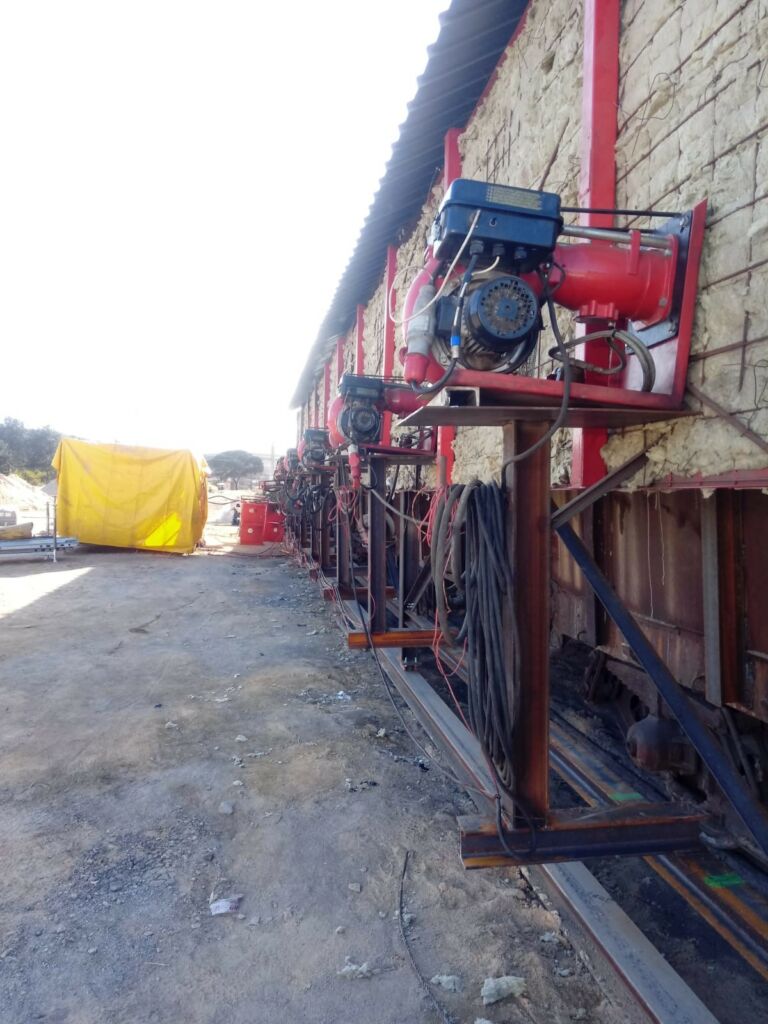
Thermal processes applied to industrial components
Depending on the type of component and service conditions, different thermal procedures can be applied to improve material performance:
Post-weld heat treatment (PWHT)
Post-weld heat treatment reduces residual stresses generated during welding.
This process is especially important in equipment such as:
- Pressure vessels
- Process piping
- Heat exchangers
- Naval structures
Controlled temperature application improves weld stability and reduces the risk of cracking or structural failure.
Welding preheating
Welding preheating is used to reduce thermal gradients during the welding process.
This procedure helps to:
- Decrease cooling rates
- Reduce diffusible hydrogen accumulation
- Prevent cracking in the heat-affected zone
Induction heating treatments
Induction heating allows rapid and localized heat application through electromagnetic fields.
This technology offers key advantages in industrial applications:
- Fast heating
- Uniform thermal distribution
- High precision in temperature control
It is particularly useful for complex components or areas with limited accessibility.
How heat treatment improves wear resistance
Material resistance to wear largely depends on its internal microstructure, which can be modified through controlled thermal cycles.
A properly applied heat treatment allows:
Increased microstructural stability
Stabilizing the material reduces the likelihood of brittle zones or metallurgical defects.
Reduction of internal stresses
Eliminating residual stresses lowers the risk of cracking and improves performance under dynamic loads.
Improved component durability
Optimizing mechanical properties extends equipment service life and reduces maintenance frequency.
In industrial facilities where downtime is costly, these benefits are especially critical.
Importance of thermal control in industrial processes
The effectiveness of a heat treatment largely depends on precise temperature control throughout the process.
To ensure thermal stability, monitoring systems are used, such as:
- Industrial thermocouples
- Digital temperature recorders
- Multi-channel thermal control systems
These tools allow temperature monitoring at different points of the component, ensuring it remains within the specified process range.
Proper monitoring of thermal parameters is essential to guarantee process repeatability and compliance with international standards.
Innovations in industrial heat treatment
Technological advancements have significantly improved the precision and efficiency of heat treatments applied to industrial equipment.
Key solutions include:
- High-precision induction heating systems
- Advanced thermal monitoring systems
- Real-time digital process control
- High-efficiency industrial heating solutions
These high-temperature solutions help optimize material performance and improve equipment reliability in demanding industrial environments.
Heat treatment as a key factor in equipment reliability
In sectors such as Oil & Gas, naval, and offshore—where operating conditions are particularly severe—heat treatment has become an essential tool for ensuring structural integrity.
Processes such as welding preheating, post-weld heat treatment, and induction heating systems improve material stability and ensure component performance throughout their service life.
Proper planning and execution of these processes help extend equipment durability, enhance operational safety, and reduce the risk of premature failure in critical industrial installations.