
Advances in high-temperature solutions have transformed the way industry approaches thermal processes. Precision applications have become the foundation of modern industrial efficiency and safety.
What Are High-Temperature Solutions and Why Are They Essential in Industry?
High-temperature solutions encompass all technologies that enable the application, maintenance, and control of heat in metallic materials and structures. These techniques are indispensable in sectors such as nuclear, offshore, oil & gas, steel manufacturing, and renewable energy.
Heat treatment not only improves material quality but also prevents structural defects and extends the service life of equipment.
Advanced Applications of Industrial Heat Treatment
Each industry requires a specific heat treatment approach, tailored to the type of material, geometry, and operating conditions. Below are some of the most relevant processes in which advanced heat treatment technology plays an essential role.
Heat Treatment of Pressure Vessels
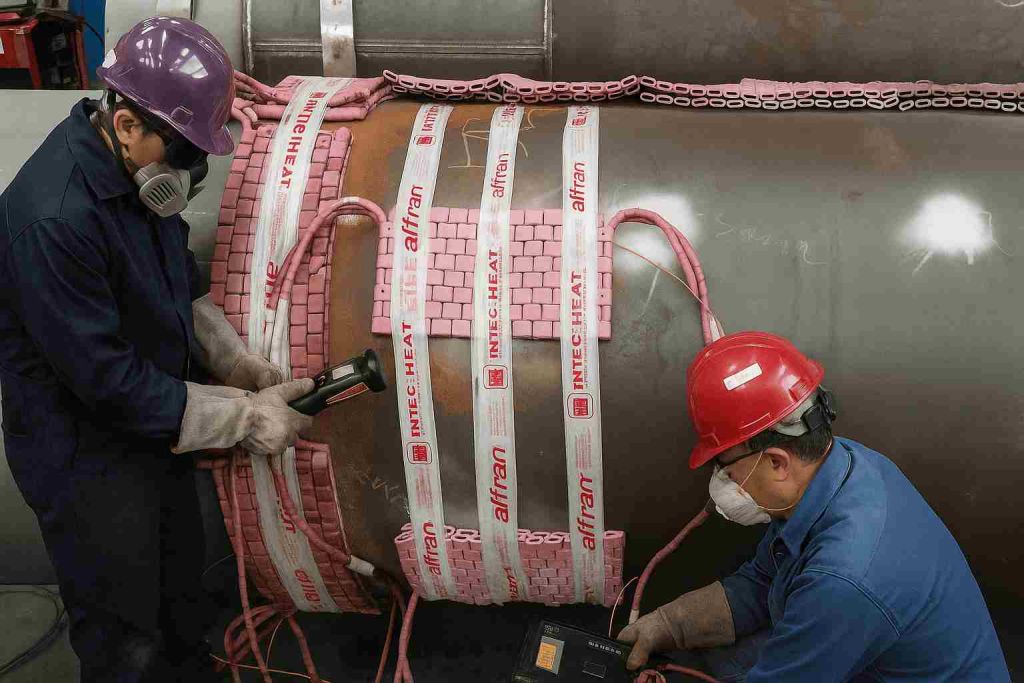
Heat treatments for pressure vessels are performed to relieve internal stresses generated during the manufacturing and welding processes. These vessels, which are subjected to extreme temperatures and pressures, require precise execution of post-weld heat treatment (PWHT) to ensure that their mechanical properties remain stable and safe.
Preheating of Sleeves on Sleeving Machines
Preheating of sleeves on sleeving machines is a process that prepares large cylindrical components prior to welding. This treatment ensures uniform temperature distribution, reducing the risk of cracks and deformations in critical joints.
Offshore Jacket Preheating and Offshore Wind Jacket Preheating
In the offshore sector, preheating of offshore jackets and offshore wind jackets is essential to ensure the quality of welds in marine structures. These applications, which are exposed to moisture and corrosion, require high-precision thermal control during manufacturing and assembly.
Nuclear Preheating and Nuclear Heat Treatment
Projects in the nuclear sector are the most demanding in terms of thermal control. Both nuclear preheating and nuclear heat treatment require specialized equipment and rigorous procedures. Metal stability and process safety are top priorities in the manufacture of components for power plants and reactors.
Induction Heating
Induction heating allows for the localized heating of metal parts using electromagnetic fields. This method offers high speed, energy efficiency, and precise temperature control, making it ideal for welding and parts with complex geometries.
Refractories and Their Role in Industrial Thermal Solutions
Refractory material is essential in any process where temperatures exceed 1,000 °C. Its function is to protect the internal surfaces of furnaces, reactors, or boilers, preventing heat loss and increasing efficiency.
Drying and curing processes must follow controlled thermal curves to prevent cracking, which is why combustion equipment, electric heating elements, or automatic gas or diesel burners are used.
Innovation and Control in Thermal Processes
Digitalization and advanced thermal engineering have ushered in a new era in heat treatment. The use of Type K thermocouples, multi-channel data loggers, and automated control systems makes it possible to record every phase of the process, ensuring traceability, safety, and regulatory compliance.
These advances have made it possible to apply heat treatments with the same precision in renewable energy plants as in marine structures or nuclear components.
Modern heat treatments represent a combination of technology, precision, and specialized knowledge that ensures the reliability of materials in highly demanding environments. From pressure vessels to offshore wind jackets or nuclear projects, thermal control is now synonymous with safety and industrial efficiency.